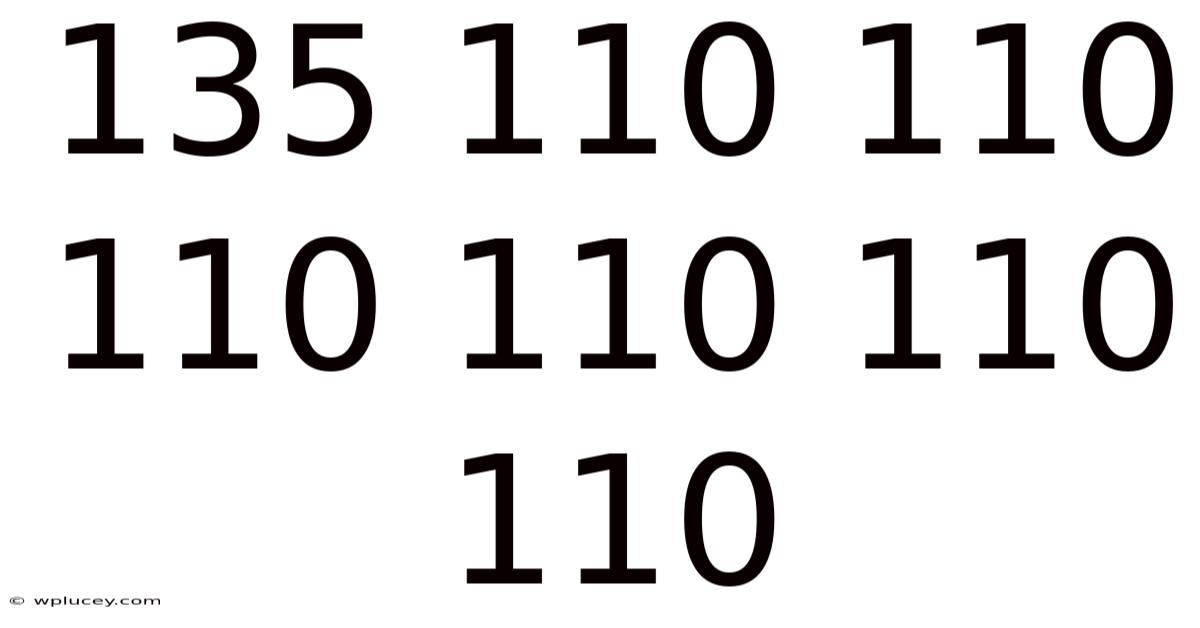
Decoding the Enigma: Exploring the Significance of the Number Sequence 135 110 110 110 110 110 110
This article looks at the mystery surrounding the number sequence 135 110 110 110 110 110 110. In real terms, we will explore various possibilities, from mathematical analyses to potential coding implications, and consider the significance of repeated numbers in pattern recognition. At first glance, it appears to be a random collection of numbers. Still, a deeper investigation reveals potential interpretations depending on the context in which it's presented. This exploration aims to uncover any hidden meanings or underlying structures within this seemingly simple sequence.
I. Mathematical Analysis: Prime Numbers and Factorization
Let's begin by examining the numbers themselves. The number 135 is a composite number; its prime factorization is 3³ x 5. We have 135 and seven instances of 110. This reveals a structure based on powers of 3 and 5 Simple, but easy to overlook. Simple as that..
- 135: 3 x 3 x 3 x 5 (3³ x 5)
- 110: 2 x 5 x 11
The prime factorization of 110 shows a different combination of prime numbers: 2, 5, and 11. And the repetition of 110 seven times immediately suggests a pattern or emphasis on this specific number. The presence of the factor 5 in both numbers hints at a possible connection, perhaps indicating a modular arithmetic relationship or a common divisor. Even so, without further context, establishing a definitive mathematical relationship remains challenging Simple as that..
II. Exploring Potential Coding Implications
Given the structure and repetition, it's natural to consider if the sequence represents a code. This is a common interpretation for numerical sequences, especially those featuring repeated numbers. Let's explore some possibilities:
- ASCII or Unicode: It's unlikely that this sequence directly maps to ASCII or Unicode characters. Those systems use numerical representations for characters, but these numbers are outside the typical ranges.
- Binary or other Number Systems: Conversion to binary or other bases doesn't immediately yield an obvious pattern or recognizable information.
- Custom Code: The most plausible explanation might involve a custom coding system. The sequence could be a key, an identifier, or part of a larger algorithm. Without knowing the specific coding system used, deciphering this becomes very difficult. The repetition of 110 could indicate a marker, a delimiter, or a repeated instruction within the code.
- Cipher: The possibility of a cipher, like a substitution cipher or a more complex encryption method, exists. To break this potential cipher, we would need additional information, such as a known plaintext or ciphertext, or hints about the encryption algorithm.
III. Pattern Recognition and the Significance of Repetition
The repetition of 110 seven times is a striking feature. Repetition in numerical sequences often signifies importance or emphasis. Several reasons for such repetition could be:
- Iteration: The sequence could represent a process that iterates seven times, with 135 initiating the process and 110 representing a step or a result repeated in each iteration.
- Emphasis: The repeated 110 could highlight a crucial piece of data or an important parameter in a larger system.
- Data Structure: In computer programming, repeated values often structure data. To give you an idea, 110 could represent a record or entry in a database, repeated seven times to accommodate seven entries.
- Modular Arithmetic: The repetition might indicate a modular operation where a cycle of seven is essential.
IV. Context is Crucial: Unveiling the Hidden Meaning
The most significant obstacle in interpreting this number sequence is the lack of context. The meaning depends heavily on where this sequence originates. Several scenarios need to be considered:
- Experimental Data: If this sequence comes from scientific experiments, it could represent measurements, observations, or trial results. Knowing the nature of the experiment is crucial for interpreting these numbers.
- Financial Data: In finance, the numbers could signify transaction IDs, account numbers, or stock prices. The context is essential in understanding their financial significance.
- Geographic Coordinates: While less likely, the sequence could represent coordinates, although the numbers seem too large for many standard coordinate systems.
- Computer Program: As discussed earlier, it could represent part of a computer program, perhaps an array, a series of instructions, or part of a data structure.
- Game Data: It could be part of game data, representing player statistics, resource amounts, or level identifiers.
V. Expanding the Investigation: Looking for Clues
To decode this sequence, we must look for clues in its origins. Questions to consider include:
- Source of the sequence: Where did this number sequence come from? Knowing the source is critical for understanding its meaning.
- Associated data: Was this sequence presented alone or with other data? What is the context in which it appeared?
- System or application: Is this sequence associated with a particular system or application? This could offer clues about its purpose and meaning.
- Pattern analysis: Are there other similar sequences? Comparing this sequence with other related ones may reveal underlying patterns or structures.
VI. The Importance of Critical Thinking and Deductive Reasoning
The ambiguity of this number sequence serves as an excellent example of the importance of critical thinking and deductive reasoning. We must approach the task systematically, exploring various possibilities and eliminating those that are implausible. So without additional information, it’s impossible to definitively determine its significance. The process of elimination, combined with creative thinking and the consideration of various contexts, is key to solving similar enigmatic sequences.
VII. Expanding the Search: Considering Alternative Interpretations
The analysis so far has focused on mathematical and coding perspectives. On the flip side, other interpretations might be possible.
- Symbolic Meaning: Could the numbers possess symbolic meaning in certain cultures or belief systems? Some number systems, particularly in numerology, ascribe special significance to certain numbers or combinations.
- Cryptography: The sequence could be part of a more complex cryptographic system, potentially employing advanced techniques beyond simple substitution ciphers.
- Hidden Message: Perhaps the sequence is an encrypted message containing a hidden meaning, requiring a specific key or algorithm to decipher.
VIII. Conclusion: The Ongoing Search for Meaning
The number sequence 135 110 110 110 110 110 110 remains an enigma. While we have explored various mathematical and coding possibilities, the lack of context prevents definitive conclusions. The repetition of 110 strongly suggests importance or pattern, but its exact meaning remains elusive. Solving this mystery requires additional information about the sequence's origin and its context within a larger system or framework. Even so, the exercise highlights the crucial role of critical thinking, deductive reasoning, and the importance of considering all available context to solve puzzles like this. Further investigation into potential sources and related information is vital to unlocking the hidden meaning of this curious number sequence. This exploration underscores the need for a multifaceted approach when confronted with such numerical enigmas. Only through comprehensive analysis and the inclusion of all relevant details can we hope to unravel the mystery and find the intended meaning behind this seemingly random arrangement of numbers.
