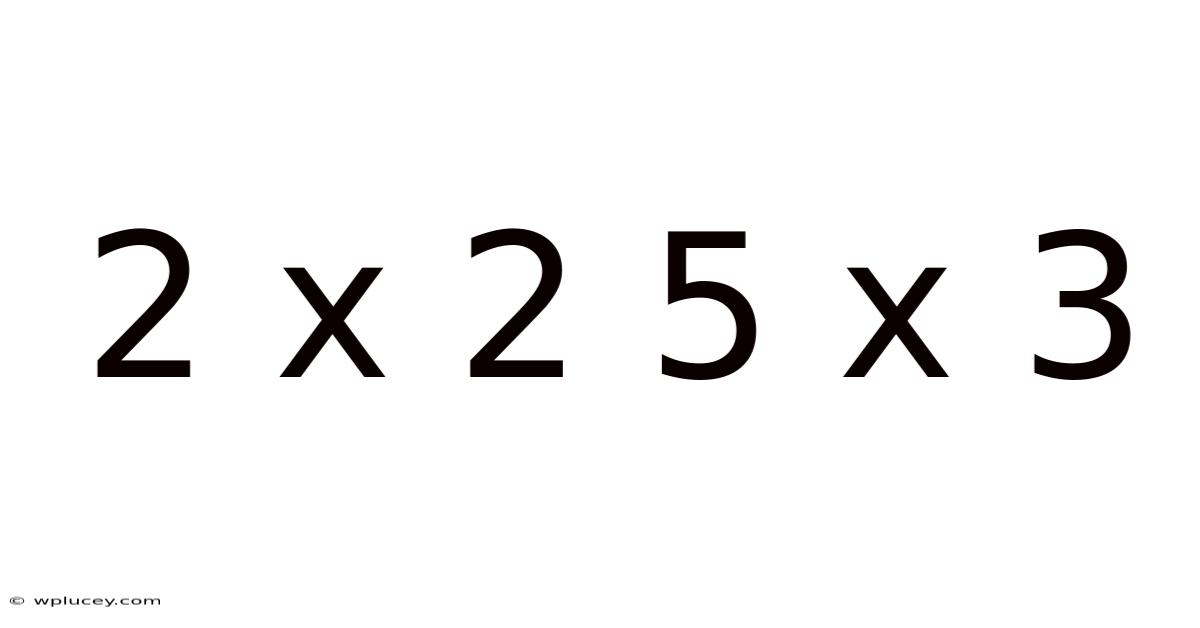
Decoding the Enigma: A Deep Dive into 2 x 2 and 5 x 3
This article explores the seemingly simple yet surprisingly rich mathematical concepts behind the expressions "2 x 2" and "5 x 3.Which means " We'll delve beyond the basic arithmetic to uncover the underlying principles, explore their applications in various fields, and examine how these seemingly elementary calculations form the foundation of more complex mathematical structures. Understanding these foundational concepts is crucial for anyone seeking to build a strong mathematical base, whether for academic pursuits or practical applications in everyday life.
I. Introduction: The Building Blocks of Multiplication
At first glance, 2 x 2 and 5 x 3 appear trivial. We readily know that 2 x 2 = 4 and 5 x 3 = 15. Still, these simple equations represent fundamental principles of multiplication, a cornerstone of arithmetic and algebra. Multiplication is essentially repeated addition. 2 x 2 means adding two twos together (2 + 2 = 4), while 5 x 3 means adding three fives together (5 + 5 + 5 = 15). This seemingly simple concept underpins many advanced mathematical operations and models Turns out it matters..
II. Exploring 2 x 2: Squares and Beyond
The expression 2 x 2 is particularly interesting because it represents the area of a square with sides of length 2. This geometric interpretation extends the concept beyond simple arithmetic. We can visualize this as a 2x2 grid, a simple yet powerful representation that appears in various contexts:
-
Geometric Representations: The 2 x 2 grid is a fundamental building block in geometry. It can be used to represent simple shapes and to introduce concepts like area and perimeter The details matter here. Which is the point..
-
Matrices and Linear Algebra: In linear algebra, a 2 x 2 matrix is a fundamental object used to represent linear transformations. These matrices are crucial for solving systems of linear equations and understanding vector spaces. A 2 x 2 matrix has the form:
| a  b |
| c  d |
where a, b, c, and d are numbers. Operations like addition and multiplication are defined for these matrices, making them essential tools in various scientific and engineering applications.
- Computer Science and Programming: The 2 x 2 structure appears frequently in computer programming, particularly in array representations and data structures. As an example, a 2x2 array can store four pieces of data in an organized format.
III. Exploring 5 x 3: Rectangles and Beyond
Similarly, 5 x 3 can be visualized geometrically as the area of a rectangle with sides of length 5 and 3. This simple representation opens doors to several mathematical and real-world applications:
-
Geometric Applications: The concept is directly applicable in calculating areas and volumes of various shapes. Understanding this principle is critical for tasks ranging from calculating the amount of paint needed to cover a wall to designing architectural structures.
-
Combinatorics: The calculation 5 x 3 can be interpreted combinatorially. Imagine you have 5 shirts and 3 pants. The total number of outfits you can create is 5 x 3 = 15. This showcases the application of multiplication in counting problems and probability.
-
Number Theory: While seemingly basic, the numbers 5 and 3 themselves have properties studied in number theory. 5 is a prime number, meaning it's only divisible by 1 and itself. 3 is also a prime number. The study of prime numbers is crucial in cryptography and other areas of mathematics.
IV. The Relationship Between 2 x 2 and 5 x 3: A Broader Perspective
While seemingly disparate, 2 x 2 and 5 x 3 share a common thread: they are both instances of multiplication, the fundamental operation of repeated addition. Understanding this underlying principle allows us to connect seemingly simple calculations to broader mathematical concepts. Both can be expressed as:
-
Repeated Addition: 2 + 2 = 4 and 5 + 5 + 5 = 15.
-
Area Calculations: Both calculations represent area calculations of geometric shapes: a square and a rectangle respectively.
-
Representations in Higher Mathematics: Both numbers are represented in more complex mathematical structures like matrices and vectors.
V. Applications in Real World Scenarios
The applications of these seemingly simple calculations extend far beyond the classroom:
-
Everyday Calculations: From calculating the cost of multiple items to figuring out the area of a room, these principles are used daily.
-
Engineering and Construction: Calculations like 2 x 2 and 5 x 3 are fundamental to structural engineering, determining dimensions and materials needed for projects Most people skip this — try not to. That's the whole idea..
-
Computer Science: As discussed earlier, these calculations are crucial in various programming and data manipulation tasks Surprisingly effective..
-
Finance: Simple multiplication is essential for calculations involving interest, discounts, and profit margins.
VI. Expanding the Scope: Beyond Basic Arithmetic
The simple calculations 2 x 2 and 5 x 3 serve as stepping stones to more complex mathematical concepts. They are building blocks for:
-
Algebra: The principles of multiplication are crucial for understanding algebraic equations and solving for unknowns.
-
Calculus: The concept of infinitesimal changes, a cornerstone of calculus, builds upon the foundational understanding of multiplication and addition.
-
Statistics: Statistical analysis often involves multiplication in calculating probabilities, variances, and other key measures.
VII. Frequently Asked Questions (FAQ)
Q1: What is the difference between 2 x 2 and 5 x 3?
A1: The primary difference lies in the magnitude of the result (4 vs 15). So while both represent multiplication, they involve different numbers and result in different products. Geometrically, one represents the area of a square, the other a rectangle.
Q2: Why is understanding 2 x 2 and 5 x 3 important?
A2: These seemingly simple calculations are foundational to understanding more complex mathematical concepts and applying mathematical principles to real-world problems. They represent the building blocks of arithmetic, algebra, and even more advanced mathematical fields.
Q3: Are there any real-world examples where these calculations are used?
A3: Yes, countless real-world examples exist. Calculating the area of a room, the cost of multiple items, the number of combinations of clothing items, and various engineering calculations all work with these basic multiplication principles.
Q4: Can these simple calculations be used in advanced mathematics?
A4: Absolutely. So these fundamental operations underpin concepts in linear algebra, calculus, statistics, and more. They serve as building blocks for advanced mathematical structures and problem-solving techniques.
VIII. Conclusion: The Enduring Power of Simple Mathematics
While seemingly insignificant at first, the calculations 2 x 2 and 5 x 3 embody fundamental mathematical principles that extend far beyond basic arithmetic. Also, from everyday calculations to advanced mathematical concepts, these simple equations serve as a cornerstone of mathematical understanding and problem-solving. Mastering these basic concepts provides a solid foundation for tackling more complex mathematical challenges and applying mathematical reasoning to real-world scenarios. Their seemingly straightforward nature belies their profound impact on various fields, highlighting the enduring power of foundational mathematical knowledge. Here's the thing — understanding these principles is crucial not only for academic success but also for navigating the complexities of our numerical world. The journey from understanding 2 x 2 and 5 x 3 to grasping advanced mathematical concepts begins with a firm grasp of these fundamental building blocks Small thing, real impact. Still holds up..
