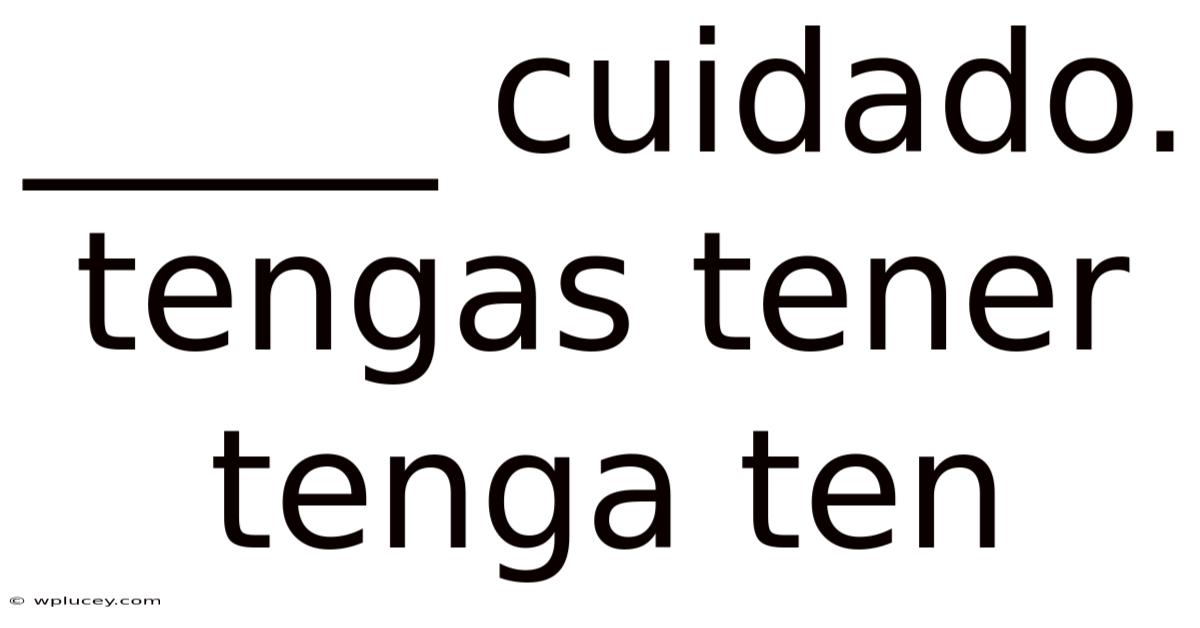
Understanding Spanish Verb Conjugation: Tener (To Have)
This article digs into the intricacies of the Spanish verb tener, meaning "to have," exploring its various conjugations across different tenses and moods. In real terms, we'll break down the conjugations, provide examples, and address common points of confusion, ensuring you gain a comprehensive understanding of this vital verb. Here's the thing — mastering tener is crucial for fluency, as it's one of the most frequently used verbs in the Spanish language. Understanding the differences between cuidados, tengas, tener, tenga, and ten is key to correct sentence structure and meaning.
Introduction to the Verb Tener
The verb tener is an irregular verb, meaning its conjugations don't follow the standard patterns of regular verbs like hablar (to speak) or comer (to eat). Day to day, this irregularity necessitates memorization, but with consistent practice, mastering its forms becomes manageable. Tener is used to express possession, but it also has numerous idiomatic uses, making it even more versatile and essential to learn. This guide will explore its various conjugations and applications, clarifying the distinctions between similar forms like cuidados, tengas, tener, tenga, and ten.
Present Tense Conjugation of Tener
The present tense (presente) is the most fundamental tense, describing actions happening now. Here's the conjugation of tener in the present tense:
| Pronoun | Conjugation | Example Sentence | Translation |
|---|---|---|---|
| Yo (I) | tengo | Tengo un coche nuevo. In practice, | I have a new car. |
| Tú (You - informal) | tienes | Tienes mucha paciencia. On top of that, | You have a lot of patience. Because of that, |
| Él/Ella/Usted (He/She/You - formal) | tiene | Tiene un perro grande. | He/She/You have a big dog. Day to day, |
| Nosotros/Nosotras (We) | tenemos | Tenemos una casa bonita. Think about it: | We have a beautiful house. |
| Vosotros/Vosotras (You - informal plural, Spain) | tenéis | Tenéis muchos amigos. | You (plural) have many friends. |
| Ellos/Ellas/Ustedes (They/You - formal plural) | tienen | Tienen tres hijos. | They/You have three children. |
Notice the irregularities in the yo (tengo), tú (tienes), él/ella/usted (tiene), and nosotros/nosotras (tenemos) forms. These deviations from regular verb patterns are what characterize tener as an irregular verb.
Other Important Tenses of Tener
Beyond the present tense, understanding other tenses is crucial for expressing a wider range of actions and situations. Let's look at some key examples:
Preterite Tense (Past Simple)
The preterite tense describes completed actions in the past. The conjugation of tener in the preterite is:
| Pronoun | Conjugation | Example Sentence | Translation |
|---|---|---|---|
| Yo (I) | tuve | Tuve un accidente. | You (plural) had a good idea. |
| Él/Ella/Usted (He/She/You - formal) | tuvo | Tuvo mucha suerte. Also, | |
| Nosotros/Nosotras (We) | tuvimos | Tuvimos una fiesta. Which means | He/She/You had a lot of luck. |
| Tú (You - informal) | tuviste | Tuviste razón. | |
| Ellos/Ellas/Ustedes (They/You - formal plural) | tuvieron | Tuvieron un bebé. That said, | |
| Vosotros/Vosotras (You - informal plural, Spain) | tuvisteis | Tuvisteis una buena idea. | They/You had a baby. |
Again, note the irregular forms compared to regular -ar verbs.
Imperfect Tense (Past Continuous/Habitual)
The imperfect tense describes ongoing or habitual actions in the past. The imperfect conjugation of tener is:
| Pronoun | Conjugation | Example Sentence | Translation |
|---|---|---|---|
| Yo (I) | tenía | Tenía un gato. | I had a cat. But |
| Tú (You - informal) | tenías | Tenías mucho trabajo. | You had a lot of work. In real terms, |
| Él/Ella/Usted (He/She/You - formal) | tenía | Tenía un coche viejo. | He/She/You had an old car. Also, |
| Nosotros/Nosotras (We) | teníamos | Teníamos una casa pequeña. | We had a small house. Day to day, |
| Vosotros/Vosotras (You - informal plural, Spain) | teníais | Teníais que estudiar. | You (plural) had to study. Here's the thing — |
| Ellos/Ellas/Ustedes (They/You - formal plural) | tenían | Tenían un secreto. | They/You had a secret. |
Observe the similarity between the imperfect forms of tener and the present tense of tener. The context is crucial for differentiating the two.
Future Tense (Simple Future)
The future tense indicates actions that will happen in the future. The future tense of tener is formed using the auxiliary verb haber and the infinitive:
Yo tendré un perro. (I will have a dog.) Tú tendrás un nuevo trabajo. (You will have a new job.) Él tendrá una oportunidad. (He will have an opportunity.)
Conditional Tense (Conditional Simple)
The conditional tense expresses actions that would happen under certain conditions. It's formed similarly to the future tense, using the conditional form of haber and the infinitive:
Yo tendría más tiempo. (I would have more time.) Tú tendrías que ir. (You would have to go.) Ella tendría una fiesta. (She would have a party.)
The Subjunctive Mood and Tener
The subjunctive mood is used to express wishes, doubts, opinions, or emotions. Which means the subjunctive forms of tener are particularly important because they often appear in dependent clauses. The most commonly used subjunctive tenses are the present and imperfect subjunctive.
Present Subjunctive:
Yo tenga (that I have) Tú tengas (that you have) Él/Ella/Usted tenga (that he/she/you have) Nosotros/as tengamos (that we have) Vosotros/as tengáis (that you all have) Ellos/as tengan (that they have)
Imperfect Subjunctive:
Yo tuviera (that I had) Tú tuvieras (that you had) Él/Ella/Usted tuviera (that he/she/you had) Nosotros/as tuviéramos (that we had) Vosotros/as tuvierais (that you all had) Ellos/as tuvieran (that they had)
These forms are used in sentences like: Quiero que tengas un buen día (I want you to have a good day) or Es importante que ella tenga paciencia (It's important that she have patience). The subjunctive is crucial for expressing nuances of meaning that are lost when only using the indicative mood That's the part that actually makes a difference. Still holds up..
Idiomatic Uses of Tener
Tener extends beyond simply expressing possession. It's used in many idiomatic expressions:
- Tener hambre: To be hungry
- Tener sed: To be thirsty
- Tener frío: To be cold
- Tener calor: To be hot
- Tener sueño: To be sleepy
- Tener miedo: To be afraid
- Tener razón: To be right
- Tener suerte: To be lucky
- Tener prisa: To be in a hurry
- Tener cuidado: To be careful (Cuidado itself is a noun meaning "care" or "caution," often used as an exclamation: ¡Cuidado!)
Understanding these idiomatic expressions significantly improves your comprehension and fluency in Spanish It's one of those things that adds up. And it works..
Analyzing the Given Words: Cuidado, Tengas, Tener, Tenga, Ten
Now let's address the specific words mentioned in the title: cuidado, tengas, tener, tenga, and ten It's one of those things that adds up..
-
Cuidado: As mentioned above, cuidado is a noun meaning "care" or "caution." It's not a conjugated form of tener. It's often used as an imperative ("Be careful!") or as a noun in a sentence: Debes tener cuidado (You should be careful) It's one of those things that adds up..
-
Tener: This is the infinitive form of the verb, meaning "to have."
-
Tenga: This is the third-person singular present subjunctive form of tener. It's used in dependent clauses, often after expressions of desire, necessity, or doubt: Espero que tenga un buen viaje (I hope you have a good trip) And that's really what it comes down to. Simple as that..
-
Tengas: This is the second-person singular present subjunctive form of tener, meaning "that you have" (informal). It’s also used in dependent clauses. For example: Quiero que tengas éxito. (I want you to succeed.)
-
Ten: This is an informal imperative form, a shortened version of ten (have). It's less common in formal Spanish. You’d use it in a short command such as Ten paciencia! (Have patience!) Not complicated — just consistent..
The difference between these words lies in their grammatical function. That's why Cuidado is a separate word altogether, related to the concept of "having care" but grammatically distinct. Tener is the base verb, while tenga and tengas are specific conjugated forms used in different contexts, mainly the subjunctive. Ten is a shortened imperative form.
Conclusion
Mastering the verb tener is a crucial step in becoming fluent in Spanish. Its irregular conjugations across various tenses and moods require dedicated learning, but the rewards are significant. This complete walkthrough has provided a detailed breakdown of its conjugations, highlighting the irregularities and offering numerous examples to aid understanding. Still, understanding the nuances between words like cuidado, tengas, tener, tenga, and ten demonstrates a deeper comprehension of Spanish grammar. Continue practicing these conjugations in diverse sentence structures, and your fluency will undoubtedly improve. That's why remember to pay close attention to context to determine the correct tense and mood of tener in any given situation. Consistent practice is key to mastering this essential Spanish verb.
